


The World Cup Is Over. Soccer Is Not.

How Houston can turn its World Cup hangover into lasting passion - and lasting business opportunity.
For several unforgettable weeks, the World Cup moved nations.
Flags appeared everywhere. Offices organized watch parties. Restaurants opened early. Families planned their days around matches. People who rarely watched soccer suddenly debated tactics, penalties and substitutions.
Now comes the inevitable World Cup hangover.
But the end of the tournament does not mean the end of the opportunity. It simply means that soccer returns to its normal - and in many ways richer - rhythm.
The World Cup moves nations. Day-to-day soccer moves teams, neighborhoods, schools, communities and families. Between World Cups, national teams continue competing in regional championships, qualification tournaments, Nations Leagues and international friendlies.
For Houston, this is not a small niche.
Audience intelligence developed by Rascasse for T.E.A.M. Houston identifies approximately 4 million soccer fans across the Houston metropolitan area, including roughly 3.05 million in the city of Houston itself. Soccer-related search interest also increased by 57% year over year during the World Cup cycle.
That tells us two things: Houston already has an enormous soccer audience - and its momentum may not yet have peaked.
The question is not: “What do we watch now?”
The real question is: “Where do we want to enter the soccer world?”
First, understand the two sides of soccer
One of the reasons soccer can be confusing to new fans is that the same player may represent both a club and a country.
A player might compete every week for the Houston Dynamo, Manchester City, Real Madrid, Club América or Tigres - and then temporarily leave that club to represent the United States, Mexico, Argentina, Spain, Nigeria or another national team.
That creates two parallel soccer worlds.

National-team soccer: countries competing against countries
This is the world’s most casual fans experienced during the World Cup.
Major men’s national-team competitions include:
FIFA World Cup and World Cup qualification
Concacaf Gold Cup and Concacaf Nations League
CONMEBOL Copa América
UEFA European Championship and UEFA Nations League
Africa Cup of Nations, AFC Asian Cup and international friendlies
The women’s national-team calendar has its own major competitions:
FIFA Women’s World Cup and qualification
Olympic women’s soccer tournament
Concacaf W Gold Cup and other Concacaf competitions
UEFA Women’s Euro and UEFA Women’s Nations League
Copa América Femenina, Women’s Africa Cup of Nations and AFC Women’s Asian Cup
The next major global destination is already on the horizon: the 2027 FIFA Women’s World Cup in Brazil.
National-team soccer is particularly relevant in Houston because its audience is connected to many countries.
Mexico leads the local market, reaching approximately 1.28 million Houston-area soccer fans in the Rascasse analysis. But the interest extends much further: approximately 1.12 million connect with the United States, followed by substantial audiences for Argentina, Brazil, Colombia, Spain, England, Germany, France and other countries.
Houston’s soccer identity is not tied to one flag. It reflects the international composition of the city itself.
For businesses, national-team soccer creates natural opportunities around cultural celebrations, hospitality, tourism, food, entertainment, watch parties and international travel. Almost every major competition has an existing Houston audience waiting to be recognized.
Club soccer: teams competing throughout the year
Club soccer provides the weekly rhythm that keeps the sport alive between international tournaments.
In North America, the central competitions include:
Major League Soccer and MLS NEXT Pro
National Women’s Soccer League
Liga MX and Liga MX Femenil
USL Championship, League One, League Two, Super League and W League
U.S. Open Cup, Leagues Cup and Concacaf Champions Cup
Concacaf W Champions Cup
For Houston, the easiest place to continue the World Cup experience is right at home:
Houston Dynamo FC in MLS
Houston Dash in NWSL
Dynamo and Dash academy and youth-development programs
College, university and high school soccer
Youth, adult, recreational, indoor, futsal and pick-up soccer
The local audience is large enough to support all these levels.
The Rascasse analysis identifies approximately 1.1 million Houston-area fans with an interest in Major League Soccer. The Houston Dynamo audience is smaller than the global giants, but it demonstrates unusually strong loyalty - evidence of a committed local core that can be developed further.
This distinction matters. Global soccer provides scale; local soccer provides proximity, participation and community.
Houston needs both.
No single competition owns Houston
New fans do not need to follow everything. But businesses should understand that Houston’s soccer audience cannot be reduced to one league, one nationality or one team.
The World Cup reached the largest audience in the local analysis, connecting with approximately 2.29 million Houston-area fans. However, several club competitions also have substantial followings:
Liga MX: approximately 1.35 million
Major League Soccer: approximately 1.1 million
Premier League: approximately 1.04 million
UEFA Champions League: approximately 848,000
La Liga: approximately 747,000
That spread is the real story.
Houston is not only an MLS market, a Liga MX market, a Mexican national-TEAM market or a Premier League market. It is all of those simultaneously.
The opportunity is therefore not to find the one soccer property that represents everybody. The opportunity is to select the part of the ecosystem that best fits a particular audience, objective and budget.

The world’s biggest leagues are only a screen away
Major League Soccer (MLS)
MLS is the most accessible starting point for Houston. The Houston Dynamo provide live soccer, local identity, client hospitality and a direct connection to the city.
MLS clubs also participate in competitions such as the U.S. Open Cup, Leagues Cup against Liga MX opposition and the Concacaf Champions Cup.
For businesses trying to establish a year-round local presence in soccer, the Houston Dynamo offer the most direct bridge between Houston’s global passion and its civic identity.
National Women’s Soccer League (NWSL)
The NWSL offers one of the strongest women’s professional soccer competitions in the world. The Houston Dash connect businesses with women’s sports, families, young athletes and Houston’s broader professional-sports community.
This is not a secondary soccer product. Women’s soccer has its own supporters, stars, rivalries, commercial potential and international storylines.
The Houston fan data also challenges the assumption that soccer is overwhelmingly male. The local audience has an estimated 46% female and 54% male split - a relatively balanced profile with only a modest male lean.
For businesses, that makes women’s soccer both a community opportunity and a significant audience opportunity.
Liga MX and Liga MX Femenil
Liga MX has an enormous following in Houston, reaching approximately 1.35 million Houston-area soccer fans. Within that audience, Club América connects with an estimated 868,000 fans, while Chivas reaches approximately 724,000. Tigres has a smaller overall audience but demonstrates exceptionally strong loyalty among its Houston supporters.
That combination of reach and affinity makes Liga MX one of Houston’s most important soccer platforms. Liga MX Femenil has also developed into an increasingly relevant part of the women’s soccer landscape.
Leagues Cup, international exhibitions and club tours can bring MLS and Liga MX audiences together, creating natural opportunities for hospitality, sponsorship and cross-cultural marketing.
Premier League
England’s Premier League reaches approximately 1.04 million Houston-area fans, making it one of the city’s largest club-soccer audiences.
Manchester United leads the Houston Premier League audience with an estimated 590,000 fans, followed by Liverpool with approximately 513,000 and Chelsea with around 353,000. Arsenal, Manchester City, Tottenham Hotspur and other clubs also have active local supporter communities.
The league’s recognizable clubs, weekend schedule and established Houston fan groups make it particularly suitable for sports bars, restaurants, breakfast events, supporter partnerships and business watch parties.
La Liga
Spain’s La Liga reaches approximately 747,000 Houston-area fans as a competition, but its two largest clubs extend far beyond the regular league audience.
Real Madrid connects with an estimated 1.16 million Houston-area soccer fans, while FC Barcelona reaches approximately 1.03 million. They are the two largest international club fan bases identified in the Houston profile - larger than the audience of any individual MLS or Liga MX club.
Their scale demonstrates that Houston’s soccer identity is global. Real Madrid and Barcelona provide natural connections to Hispanic, European and international audiences, as well as to newer fans who entered soccer through its biggest clubs, players and rivalries.
The wider European game
Fans can also explore Germany’s Bundesliga, Italy’s Serie A, France’s Ligue 1, the Dutch Eredivisie, Portugal’s Primeira Liga and many other domestic competitions.
The leading clubs then meet in continental tournaments:
UEFA Champions League
UEFA Europa League and Conference League
UEFA Women’s Champions League
UEFA Women’s Europa Cup
The Champions League alone reaches an estimated 848,000 Houston-area fans. That represents a substantial business audience for weekday afternoon viewing, client events and international brand programming.
South America, Africa and beyond
South American club soccer includes famous domestic competitions in Brazil and Argentina, together with Copa Libertadores, Copa Sudamericana and Copa Libertadores Femenina.
Africa offers vibrant domestic leagues, the CAF Champions League, CAF Women’s Champions League and national-team competitions that resonate across Houston’s growing African communities.
There is also significant club and national-team soccer across Asia, the Middle East, the Caribbean and Central America.
There is no single “correct” soccer journey. A Houston fan can follow the Dynamo on Saturday, watch the Premier League on Sunday morning, support Mexico or the United States during an international window and discover a college or neighborhood match during the week.
Houston’s soccer audience is young, active and broad
Houston’s soccer audience is not a narrow demographic niche.
According to the Rascasse profile:
The average fan age is approximately 38.4
The estimated gender split is 46% female and 54% male
Both women and men aged 16–19 over-index compared with the national average
The audience is characterized as active, social and digitally engaged
The core audience is comfortable moving between global soccer culture and local Houston life
This matters for organizations considering how to engage.
Soccer can reach young people and families, but it is not limited to youth marketing. It can reach professionals, managers, multicultural households, international executives, local entrepreneurs and established consumers.
Many soccer fans also support the Rockets, Astros, Texans and other Houston teams. But soccer is not simply an occasional addition to their sports behavior. For many, it is their primary sporting passion.
Marketing should therefore connect global soccer passion with Houston pride - not force audiences to choose between them.
Soccer is not limited to the professional game
Some of the most meaningful opportunities are much closer to home.
Houston-area colleges and universities offer competitive soccer in an accessible environment. Programs at Rice, the University of Houston, Houston Christian University, Texas Southern, Prairie View A&M and other institutions provide opportunities to watch and support student-athletes.
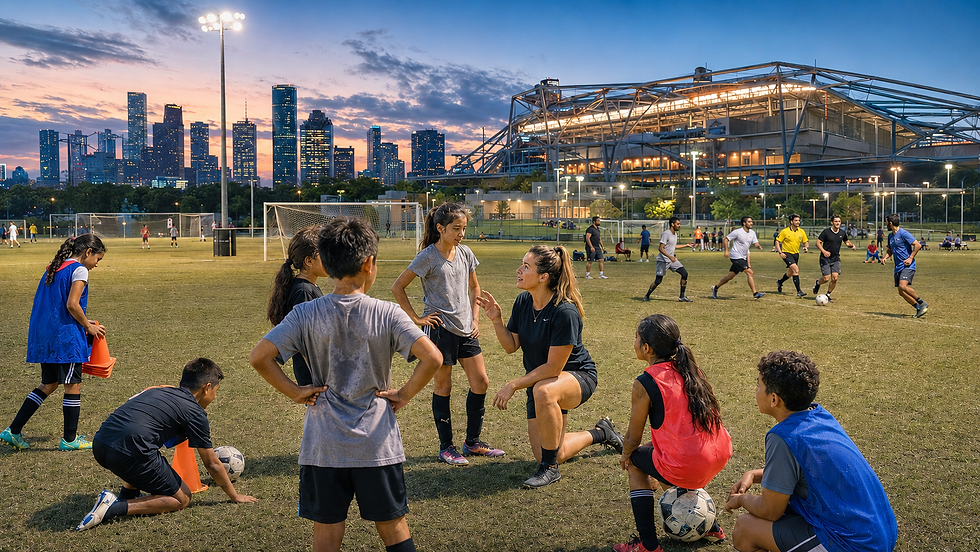
High school soccer connects businesses directly with neighborhoods, families and future talent. Youth clubs and academies reach thousands of Houston-area players every week. Adult recreational leagues, women’s leagues, corporate teams, futsal, indoor facilities and informal pick-up groups make soccer a participation platform - not just a spectator sport.
Businesses can also support the infrastructure that makes the game possible:
Coaches, referees and volunteer development
Fields, facilities, equipment and transportation
Scholarships and access for underserved players
Athletic training, nutrition and player safety
Technology, video, marketing and media support
The ecosystem is broad enough to accommodate almost any kind of involvement. A company does not need a stadium-sized budget to participate or make a meaningful contribution.
Soccer engagement is year-round - but not uniform
Houston’s soccer activity does not follow a single season.
The local data shows engagement peaks during July through September and again during November and December. These periods align with combinations of Liga MX, MLS playoff races, international competitions and major club calendars.
For businesses, this means soccer planning should not be limited to one summer tournament.
There are opportunities to create different moments throughout the year:
A major international tournament may generate broad public awareness
A club season can support recurring customer or employee engagement
A local match can create intimate client hospitality
A youth or community program can build long-term credibility
A watch-party series can develop a consistent fan community
Soccer works best as a calendar, not as a one-time campaign.
Where can businesses enter the soccer ecosystem?
The best starting point is not selecting a sponsorship package. It is identifying the business objective.
Soccer offers opportunities at almost every level, for almost every audience and at almost every budget. A multinational company may build a major hospitality program around international competitions, while a local business may sponsor a youth team, host a watch party or support a community field.
The important thing is to select an angle that is authentic to the company, relevant to its
audience and realistic for its available resources.
1. Client development and hospitality
Soccer creates a relaxed, energetic environment in which relationships can develop naturally. Businesses can use matches and soccer experiences to engage current clients, open conversations with prospective customers or strengthen international partnerships.
Potential activities include:
Dynamo or Dash match hospitality
International or college match experiences
Client watch parties
Soccer-themed dinners and networking receptions
Premium travel to major competitions
The right activity depends on the audience. A local customer may value a night at Shell Energy Stadium, while an international client may connect more strongly with a national team or club from their home country.
2. Employee engagement
Houston companies often employ people connected to many different countries, clubs and soccer traditions. That diversity can become an internal-strength and culture-building platform.
Possible approaches include:
Office watch parties and prediction competitions
Corporate soccer teams or tournaments
Employee and family soccer days
Volunteer programs with youth organizations
International soccer and cultural celebrations
The relatively balanced gender profile and strong engagement among younger fans also make soccer suitable for broad employee and family programming - not only for a traditional male sports audience.
3. Community impact
Soccer reaches families and neighborhoods that may not always connect with traditional corporate programs. Supporting access to the game can become a visible and practical part of a company’s community strategy.

Examples include:
Youth-player scholarships and fee assistance
Equipment, uniforms and transportation
Coaching and referee development
Field access and facility improvements
Support for women’s, adaptive or underserved programs
A focused contribution can have a significant impact. Consistently helping one credible neighborhood organization may create more value than spreading a limited budget across many unrelated activities.
4. Brand marketing
Houston soccer fans are global in taste but local in their daily lives.
They may follow Real Madrid, Barcelona, Club América, Chivas, Manchester United or the Mexican national team while also supporting the Dynamo, Rockets, Astros, Texans, Houston restaurants and local businesses.
That creates opportunities for:
Team, league or event sponsorship
Player, supporter-group or creator partnerships
Branded content and soccer storytelling
Watch-party or fan-engagement campaigns
Multicultural and community-focused activations
The best strategy is rarely “soccer fans” as one broad target. A business should determine which part of Houston’s soccer audience it wants to reach and what authentic value it can offer that community.
5. Hospitality and entertainment
The World Cup demonstrated how strongly people want to experience soccer together. Restaurants, bars, hotels, event venues and entertainment districts can continue serving that demand throughout the year.
Possible concepts include:
League or club-focused watch parties
Dynamo and Dash pregame or away-game events
Women’s soccer programming
International food-and-soccer experiences
Soccer trivia, live media or supporter events
The opportunity is not necessarily to show every match. It is to become a recognized home for a particular community, league or soccer experience.
6. Business-to-business networking
Soccer can be more than the subject of an event. It can become the platform that brings Houston companies, entrepreneurs, investors and community leaders together.
The sport touches hospitality, tourism, technology, media, transportation, healthcare, retail, education, real estate and many other industries.

Potential formats include:
Houston Soccer Business Breakfast
Soccer-industry networking events
Sports technology and innovation sessions
Multicultural marketing or hospitality workshops
International business and market-entry programs
With four million soccer fans in the metropolitan area, soccer is not separate from Houston’s business community. Those fans are employees, customers, owners, executives, entrepreneurs and decision-makers.
7. Travel and international business
Houston’s international connectivity makes soccer travel particularly relevant. Major competitions can become anchors for client programs, incentive travel, trade missions and international business development.
Possible destinations or programs include:
Gold Cup and Nations League matches
Women’s World Cup 2027 in Brazil
Premier League, La Liga or Liga MX experiences
Major international club competitions
Soccer-focused business missions
The business value comes from designing an integrated program around the event - not treating the match as a stand-alone excursion.
There is enough soccer for everyone
The size of the soccer ecosystem can initially feel overwhelming. There are hundreds of leagues, thousands of teams and countless competitions, communities and ways to participate.
But that enormous variety is also the opportunity.
Houston already has:
Four million metropolitan-area soccer fans
Major audiences for international and domestic competitions
Strong connections to Mexico, the United States, Europe and South America
An almost evenly balanced female and male audience
A young, active and socially engaged emerging generation
Professional clubs, colleges, schools, academies and recreational communities
There is enough soccer for every type of business, every audience and almost every budget.
A company can engage professional or grassroots soccer, men’s or women’s soccer, local or international audiences, spectators or active participants.
The objective is not to participate everywhere. It is to find the place within the ecosystem where the company can be relevant, credible and consistent.
Start with one authentic connection
New fans do not need to follow every league, and businesses do not need to sponsor every activity.
Start with one authentic connection.
Choose the local team. Choose the country connected to your employees or customers. Support a women’s team your daughter can follow. Attend a college match. Join a pick-up game. Sponsor a neighborhood academy. Host a client event. Help provide access for children who otherwise could not participate.
The World Cup showed us how soccer can move nations.
The opportunity now is to use that energy to move teams, communities and businesses - 365 days a year.
T.E.A.M. Houston: helping businesses find their place in soccer
T.E.A.M. Houston is continuing its efforts of educating and supporting Houston’s business community across the soccer ecosystem.
If your organization wants to better understand Houston’s soccer fans, identify the right audience, explore sponsorship opportunities, create an event, organize client hospitality, support a community program or develop a broader soccer strategy, we invite you to reach out.
You do not need to arrive with a completed plan. We can help you understand the landscape, identify the most relevant opportunities and connect your business with appropriate teams, leagues, venues, communities and partners.
A separate downloadable Soccer Ecosystem Guide provides links to the leading federations, national-team competitions, domestic leagues and international club tournaments, together with their typical seasons and U.S. viewing options.
There is an angle for almost every business. The challenge is finding the right one.
The World Cup may be over.
Houston’s soccer journey is only beginning.
Book your exploratory FREE call here: https://calendly.com/jlb-mtg/intro-team-houston
Download #1: The Houston Soccer Fan – CLICK HERE
Download #2: The Soccer Ecosystem Guide – CLICK HERE
Houston audience estimates are based on Rascasse audience-intelligence research prepared for T.E.A.M. Houston. Figures represent modeled audience interest and overlap, not ticket sales or conventional survey counts.


Comments